By Robfej Real Estate Development Ltd. | September 2026
Buying land in Lagos can be one of the most important financial decisions you make. But in a market where new roads, industrial projects and expanding communities are changing the value of entire corridors, the biggest mistake is to focus only on the price per plot.
A cheap plot is not automatically a good investment.
Before you transfer money for land in Lagos in 2026, you need to understand exactly what you are buying, who has the right to sell it, what documents support the transaction, where the land is located, and whether there are restrictions that could affect your plans.
This is especially important in emerging areas such as Ibeju-Lekki, Epe, Sangotedo, Abijo, Eleko, Bogije, Awoyaya and surrounding growth corridors, where development is changing the profile of previously less-developed communities.
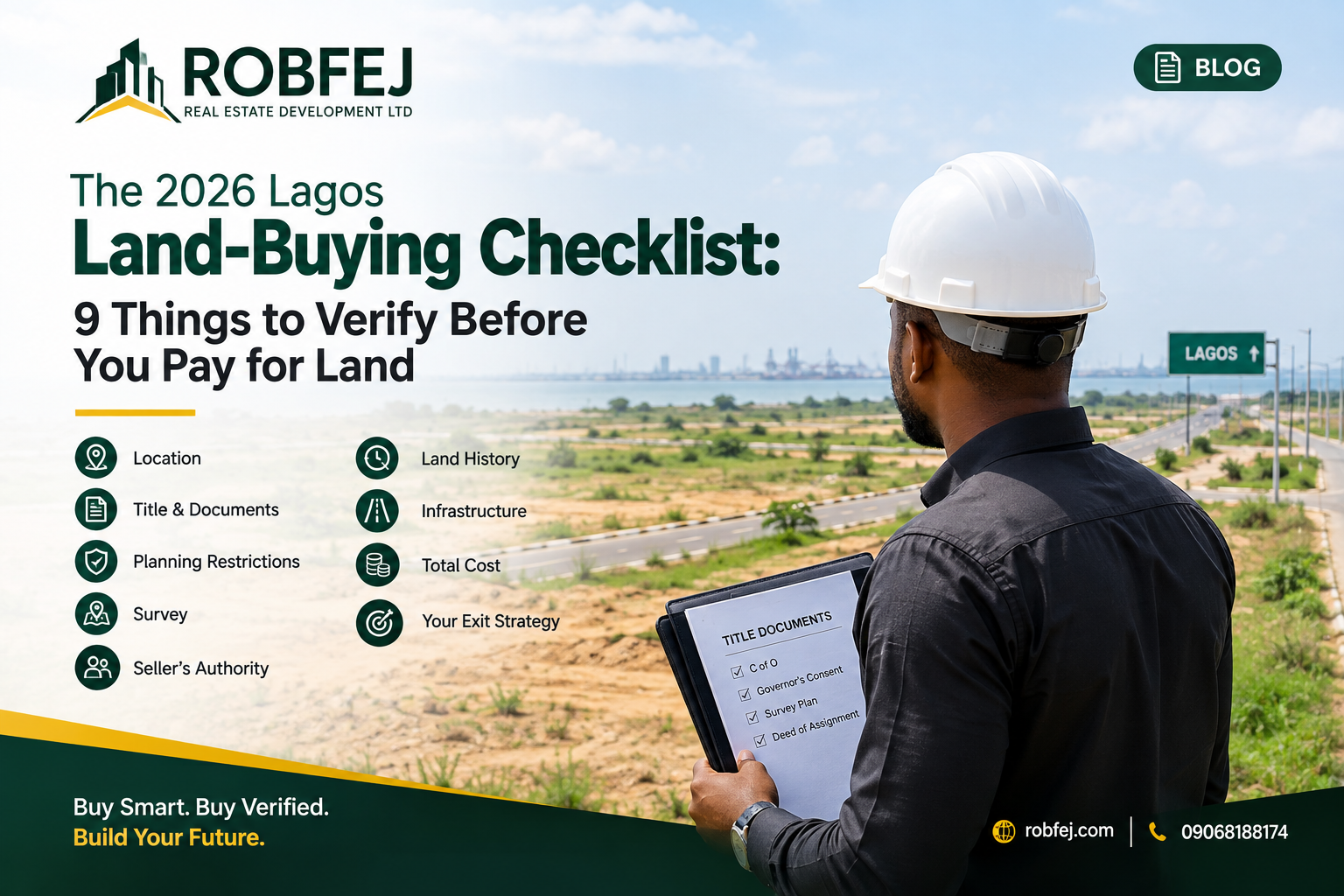
Here are nine things every serious land buyer should check.
1. Confirm the Exact Location
Never buy land based solely on a WhatsApp location pin, a landmark, or a sales agent’s description.
Ask for the exact plot number, scheme layout, survey information and coordinates where applicable. Visit the property physically and compare the location with the documents presented to you.
A property described as “close to the expressway” could mean several kilometres away. Likewise, “beside the new road” does not necessarily mean the land has direct access to that road.
Location should be confirmed on the ground and against the relevant documentation.
2. Investigate the Title
The title is one of the most important parts of a land transaction.
Depending on the property, you may encounter documents such as a Certificate of Occupancy (C of O), Governor’s Consent, registered deed, survey plan, allocation documents, excision-related documentation or other evidence of title.
However, seeing a document is not the same as independently confirming the property.
Lagos State provides an electronic land administration platform that allows users to conduct property searches and access land information, including transaction history and Certified True Copy services.
The appropriate verification process will depend on the property’s ownership history and title.
3. Check for Government Acquisition and Planning Restrictions
A plot can look perfect on inspection and still have a problem that is not immediately visible.
Before purchasing, investigate whether the land falls within a government acquisition, committed area, road alignment, drainage corridor, reservation, setback or another planning restriction.
This is particularly relevant in areas experiencing major infrastructure development.
The Lagos State planning framework requires evidence of title documents as part of relevant planning-permit processes, while additional planning and technical requirements may apply depending on the type and scale of development.
The lesson is simple: do not assess land only by what you can see on the surface.
4. Don’t Ignore the Survey
A survey is more than a piece of paper showing dimensions.
Survey information helps identify the property’s boundaries and position and can be used to compare the land with available mapping and planning information.
For an investor, this matters because two properties that appear to be next to each other can have completely different positions, dimensions, planning implications or title histories.
Ask for the survey plan and make sure the information corresponds with the actual property being sold.
5. Understand Who Is Selling the Land
Always establish the root of title and the authority of the person or company selling the property.
Depending on the transaction, the seller may be an individual owner, family, corporate entity, developer or another party with legally established authority to dispose of the property.
Do not assume that possession of documents automatically gives someone the unrestricted right to sell.
Where necessary, legal professionals should review the ownership structure, transaction documents and relevant searches before payment is completed.
6. Investigate the Land’s History
One of the most overlooked questions is:
What happened to this land before I arrived?
A property may have passed through several transactions before being offered to a new buyer.
This is why due diligence should look beyond the current seller.
Ask questions about previous ownership, existing allocations, previous sales, litigation, encumbrances and community-related interests where applicable.
Lagos’ land administration system provides tools for property searches and access to land information, making verification an important part of the buying process.
A serious buyer should be more interested in a property’s history than in a seller’s promises.
7. Examine the Infrastructure Around the Land — Not Just the Hype
Infrastructure can influence the attractiveness and future usability of land, but buyers should separate confirmed infrastructure from marketing speculation.
The eastern Lagos corridor continues to attract major infrastructure and industrial investment.
The Dangote Petroleum Refinery is located in the Lekki Free Zone in Ibeju-Lekki and currently has a stated crude distillation capacity of 700,000 barrels per day.
The federal government also continues to report ongoing work on the Lagos-Calabar Coastal Highway, with the project advancing in sections. In September 2026, the State House reported that the Ogun section was scheduled for completion before the end of 2026 and described the highway as an important connection for the developing coastal industrial corridor.
These developments help explain why investors continue to watch areas along the Lekki-Epe and Ibeju-Lekki axis.
But proximity to a major project does not automatically make every surrounding plot a good investment.
The exact distance, access road, title, development restrictions and surrounding land use still matter.
8. Calculate Your Total Acquisition Cost
The advertised price of a plot is rarely the only cost involved.
Depending on the transaction, buyers may have additional expenses relating to documentation, legal work, surveying, registration, development, infrastructure or other transaction-specific charges.
Before committing your money, request a clear breakdown of the total acquisition cost.
This allows you to compare properties properly.
A plot priced at ₦X with significant additional costs can ultimately be more expensive than a properly documented property with a higher initial asking price.
Always compare the total cost of acquisition, not just the headline price.
9. Decide Your Exit Strategy Before Buying
Why are you buying the land?
Your answer should influence the location and type of property you choose.
Some buyers want land for a future home. Others are interested in land banking, commercial development, resale, rental income or long-term family wealth.
Those objectives are not identical.
For example, a location that makes sense for long-term land banking may not be suitable for someone who wants to build immediately. Likewise, an investor looking for commercial property needs to consider road access, surrounding development and future demand rather than simply buying the cheapest available plot.
Before you pay, ask yourself:
What exactly will make this property more valuable or more useful to me in the future?
That question forces you to look beyond the excitement of a discounted offer.
Why Due Diligence Matters More as Lagos Expands
Lagos is expanding rapidly, and infrastructure is changing the economic significance of locations that were previously considered peripheral.
That creates genuine opportunities, but it also creates an environment where buyers can be tempted by urgency, unusually cheap prices and ambitious appreciation promises.
A responsible property decision requires evidence.
At Robfej Real Estate Development Ltd., our approach is built around helping buyers understand the property before they commit to it. We place emphasis on location, documentation, due diligence and the practical factors that affect a property’s long-term potential.
For buyers considering locations across Lagos, including the Lekki-Epe and Ibeju-Lekki corridors, the objective should not simply be to find cheap land.
The objective should be to acquire properly investigated land at a price that makes sense for your investment strategy.
Final Thoughts
In 2026, buying land in Lagos requires more than seeing a beautiful estate, hearing about a new road or receiving a limited-time offer.
Ask questions.
Verify the location.
Investigate the title.
Check planning restrictions.
Understand the seller’s authority.
Review the survey.
Study the infrastructure.
Calculate the full cost.
And most importantly, know why you are buying.
Real estate can create long-term wealth, but the quality of the decision begins long before construction starts. It begins with what you verify before making payment.
Looking to buy verified land in Lagos?
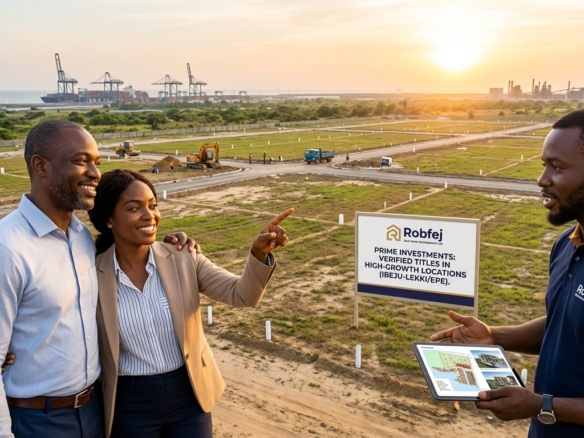
Speak with Robfej Real Estate Development Ltd. to discuss available properties and find a location that aligns with your investment objective.
Website: robfej.com
Phone: 09068188174



Join The Discussion