For years, buying land back home meant sending money into a black hole of uncertainty. But thanks to tech, transparency, and a new breed of developers, the script is flipping.
If you live abroad, you’ve heard the horror stories. Maybe you even have one of your own.
You send money home to a relative (let’s call him “Uncle Tunde”) to buy a plot of land or start a foundation. For months, you get vague updates. “We are clearing the bush,” he says on the phone. “Materials are expensive, send more funds.”
Then, you finally fly home for Christmas, drive to the site, and find… nothing. Just an empty field and a very apologetic uncle driving a suspiciously new car.
For decades, this was the “Diaspora Tax”—the high cost of trying to invest in a market you couldn’t physically see. The distance made verification impossible, and the risk felt too high.
But something is changing.
If you’ve been paying attention to the Lagos real estate scene lately, you might have noticed a shift. The era of blind trust is ending, and the era of verified receipts is taking over. Here is how local developers are finally fixing the trust deficit.
1. We Moved From “Trust Me” to “Show Me”
In the old days, a developer’s reputation was based on word-of-mouth. Today, it’s based on evidence.
Modern diaspora investors aren’t interested in promises. They want proof. And the new wave of developers knows this. They are replacing “don’t worry about it” with structured, visible processes.
- Verified Titles: No more “processing” excuses. You see the C of O or Gazette before you pay.
- Visual Timelines: You see the layout of the estate before a single brick is laid.
The game has changed from persuasion to documentation.
2. Technology Killed the Distance
Ten years ago, you had to rely on a grainy photo sent via email to see your land. Today? You can tour your investment from your living room in London or Houston.
Technology has shrunk the Atlantic Ocean.
- Video Calls: Agents are doing live walkthroughs on WhatsApp.
- Drone Footage: Developers are sending weekly 4K aerial shots showing land clearing, road construction, and perimeter fencing.
- Digital Portals: Documents are scanned and uploaded to secure cloud folders instantly.
You no longer need to rely on a third party’s interpretation of progress. You can see the tractors moving yourself. Visibility creates accountability.
3. Developers Are Becoming Educators
There is a massive shift in how developers speak to clients. The shady salesmen of the past thrived on your ignorance. The new generation thrives on your understanding.
You’ll notice that reliable developers are now acting like teachers. They are writing blogs, making videos, and hosting webinars explaining:
- The difference between a Deed of Assignment and a Survey Plan.
- Why “Government Committed” land is a trap.
- How zoning laws in Lagos actually work.
When a developer takes the time to teach you the rules of the game, it signals that they aren’t trying to cheat you—they are trying to partner with you.
4. Structure is the New Sexy
It sounds boring, but “operational structure” is the hottest thing in Nigerian real estate right now.
Diaspora investors are used to systems that work (like in the UK or US). They expect emails to be answered in 24 hours. They expect contracts to be clear. They expect receipts to be automated.
Local developers who are serious about the diaspora market are adopting these corporate structures. They are proving that you don’t need to be physically present to have a professional transaction.
5. Why the “Robfej” Model Works
This shift isn’t just theoretical; it’s happening on the ground.
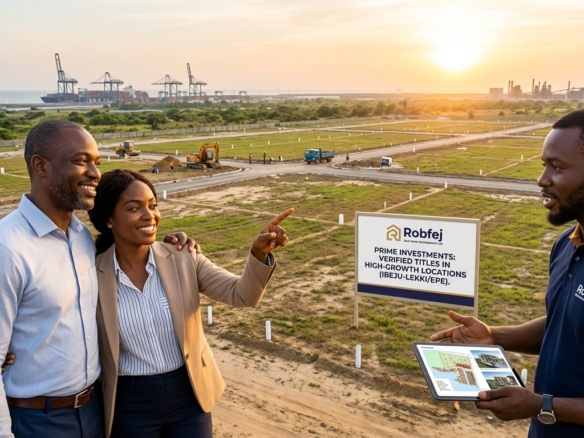
Take a look at how we operate at Robfej Estate Development. We realized early on that our clients abroad didn’t need more sales pitches—they needed peace of mind.
- We focus on documentation transparency (showing you the legal status upfront).
- We prioritize infrastructure planning (so you know exactly where the drainage and roads go).
- We keep the communication loop open long after the money is paid.
It’s not magic. It’s just good business.
The Bottom Line
The “Uncle Tunde” stories will always be around as cautionary tales. But they are no longer the only reality.
The gap between Lagos and the rest of the world is closing. Through technology, transparency, and better business practices, the Nigerian property market is becoming accessible, safe, and profitable for those living abroad.
You don’t need to fly home to build wealth anymore. You just need to find a partner who values process as much as you do.